Novel dihydroartemisinin derivatives exhibiting anticancer and antimalarial activities
Author affiliations
DOI:
https://doi.org/10.15625/2525-2518/20293Keywords:
artemisinin, dihydroartemisinin, antimalarial, cytotoxicityAbstract
A two-step procedure was used for the synthesis of six novel derivatives of artemisinin, a main active sesquiterpene lactone, which could be easily isolated on a large scale from the traditional medicinal plant Artemisia annua L in Vietnam. Structures of the prepared derivatives were characterized by full-length data of spectra, including 1H-, 13C-NMR and HRMS. Screening for their in vitro cytotoxic activity was performed together with dihydroartemisinin (DHA) against three human cancer cell lines: HepG2, A549, and HeLa. Additionally, these derivatives were evaluated for antimalarial activity against P. plasmodium using the chloroquine-resistant strain (K1) and the chloroquine-sensitive strain (T96). The results showed that the prepared derivatives exhibited the cytotoxic activity against HepG2, LU-1, and HeLa cells with IC50 values ranging from 1.32-18.38 µg/mL, which were stronger than that of DHA. Moreover, the anti-malarial results were promising for the development of new anti-malarial drugs.
Downloads
References
1. Khanal P. - Antimalarial and anticancer properties of artesunate and other artemisinins: current development. Monatsh. Chem., 152(4) (2021) 387-400. https://doi.org/10.1007/s00706-021-02759-x.
2. Karunajeewa H. A. - Artemisinins: Artemisinin, Dihydroartemisinin, Artemether and Artesunate. In Milestones in Drug Therapy, 21 (2012) 157-190.
3. Hou J., Wang D., Zhang R., Wang H. - Experimental therapy of hepatoma with artemisinin and its derivatives: In vitro and In vivo activity, chemosensitization, and mechanisms of action. Clin. Cancer Res., 14(17) (2008) 5519-5530. https://doi.org/10.1158/1078-0432.CCR-08-0197.
4. Liu Y., Liu Z., Shi J., Chen H., Mi B., Li P., Gong P. - Synthesis and Cytotoxicity of novel 10-substituted dihydroartemisinin derivatives containing N-arylphenyl-ethenesulfonamide groups. Molecules, 18(3) (2013) 2864-2877. https://doi.org/10.3390/molecules18032864.
5. Zhang B., Zhang Z., Wang J., Yang B., Zhao Y., Rao Z., Gao J. - Dihydroartemisinin sensitizes Lewis lung carcinoma cells to carboplatin therapy via p38 mitogen-activated protein kinase activation. Oncol. Lett., 15(5) (2018) 7531-7536. https://doi.org/10.3892/ol.2018.8276.
6. Cloete T. T., Breytenbach J. W., Kock C. D., Smith P. J., Breytenbach J. C., N'Da D. D. - Synthesis, antimalarial activity and cytotoxicity of 10-aminoethylether derivatives of artemisinin. Bioorg. Med. Chem., 20(15) (2012) 4701-4709. https://doi.org/10.1016/j.bmc.2012.06.014.
7. Posner G. H., Ploypradith P., Parker M. H., O'Dowd H., Woo S. H., Northrop J. - Antimalarial, antiproliferative, and antitumor activities of artemisinin-derived, chemically robust, trioxane dimers. J. Med. Chem., 42(21) (1999) 4275-4280. https://doi.org/10.1021/jm990363d.
8. Jones M., Mercer A. E., Stocks P. A., La Pensée L. J. I., Cosstick R., Park B. K. - Antitumour and antimalarial activity of artemisinin-acridine hybrids. Bioorg. Med. Chem. Lett., 19(7) (2009) 2033-2037. https://doi.org/10.1016/j.bmcl.2009.02.028.
9. N'Da D., Lombard M., Clark J., Connelly M., Matheny A., Sigal M., Guy K. R. - Antiplasmodial activity and cytotoxicity of 10β-aminoquinolinylethylethers of Artemisinin. Drug Res., 63(02) (2013) 104-108. https://doi.org/10.1055/s-0032-1333295.
10. Jordheim L. P., Durantel D., Zoulim F., Dumontet C. - Advances in the development of nucleoside and nucleotide analogues for cancer and viral diseases. Nat. Rev. Drug Discov., 12(6) (2013) 447-464. https://doi.org/10.1038/nrd4010.
11. Zenchenko A. A., Drenichev M. S., Il'icheva I. A., Mikhailov S. N. - Antiviral and Antimicrobial nucleoside derivatives: Structural features and mechanisms of action. Mol. Biol., 55(6) (2021) 786-812. https://doi.org/10.1134/S0026893321040105.
12. Prasad R. J., Reddy M. P., Rao B. N., Chowdary N. V. - An improved process for the preparation of gefitinib. WO2005070909A1, (2005). https://patents.google.com/patent/WO2005070909A1/en.
13. Nam P. D., Truong V. V., Phuong B. T. H., Trang D. T. T., Quang H. D., Thuy D. T. T. - Synthesis of acridon acetic acid used as material producing immune enhancing drug. Vietnam J. Chem., 50(4A) (2012) 73-76. (in Vietnamese).
14. Truong N. H., Tran T. H. H., Hoang K. C., Ninh D. B., Le V. D., Le D. A., Luu V. C. - Novel Thioethers of dihydroartemisinin exhibiting their biological activities. Heteroatom Chem., 2023 (2023) 1-10. https://doi.org/10.1155/2023/6761186.
15. Likhitwitayawuid K., Angerhofer C. K., Cordell G. A., Pezzuto J. M., Ruangrungsi N. - Cytotoxic and Antimalarial Bisbenzylisoquinoline Alkaloids from Stephania erecta. J. Nat. Prod., 56(1) (1993) 30-38. https://doi.org/10.1021/np50091a005.
16. Skehan P., Storeng R., Scudiero D., Monks A., McMahon J., Vistica D. - New Colorimetric Cytotoxicity Assay for Anticancer-Drug Screening. J. Natl. Cancer Inst., 82(13) (1990) 1107-1112. https://doi.org/10.1093/jnci/82.13.1107.
17. Roszczenko P., Holota S., Szewczyk O. K., Dudchak R., Bielawski K., Bielawska A., Lesyk R. - 4-Thiazolidinone-Bearing Hybrid Molecules in Anticancer Drug Design. Int. J. Mol. Sci., 23(21) (2022) 13135. https://doi.org/10.3390/ijms232113135.
18. Li Y., Zhu Y. M., Jiang H. J., Pan J. P., Wu G. S., Wu J. M., Shi Y. L., Yang J. D., Wu B. A. - Synthesis and antimalarial activity of artemisinin derivatives containing an amino group. J. Med. Chem., 43(8) (2000) 1635-1640. https://doi.org/10.1021/jm990552w.
Downloads
Published
How to Cite
Issue
Section
License

This work is licensed under a Creative Commons Attribution-ShareAlike 4.0 International License.
Vietnam Journal of Sciences and Technology (VJST) is an open access and peer-reviewed journal. All academic publications could be made free to read and downloaded for everyone. In addition, articles are published under term of the Creative Commons Attribution-ShareAlike 4.0 International (CC BY-SA) Licence which permits use, distribution and reproduction in any medium, provided the original work is properly cited & ShareAlike terms followed.
Copyright on any research article published in VJST is retained by the respective author(s), without restrictions. Authors grant VAST Journals System a license to publish the article and identify itself as the original publisher. Upon author(s) by giving permission to VJST either via VJST journal portal or other channel to publish their research work in VJST agrees to all the terms and conditions of https://creativecommons.org/licenses/by-sa/4.0/ License and terms & condition set by VJST.
Authors have the responsibility of to secure all necessary copyright permissions for the use of 3rd-party materials in their manuscript.




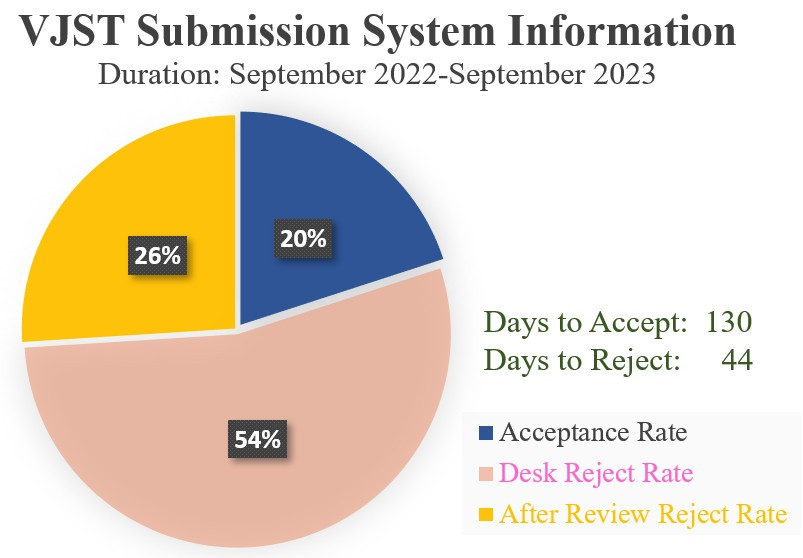
 Vietnam Journal of Science and Technology (VJST) is pleased to notice: