Assessment of some properties, morphology and film-forming ability of polycaprolactone/xanthan gum/chrysophanol composites
Author affiliations
DOI:
https://doi.org/10.15625/2525-2518/21258Keywords:
biocomposite film, solution casting method, emulsifiers, morphologyAbstract
This study presents the effect of some auxiliary agents (polyethylene oxide (PEO), polyethylene glycol (PEG), Tween 80, and Tween 20) on the film-forming ability, properties, and morphology of the PCL/XG/CSP composites. The composite films were prepared by the solution casting method, in which PCL and CSP were dissolved in dichloromethane and XG was dissolved in distilled water. The emulsifiers such as PEG, Tween 80, and Tween 20 in liquid form were added to the PCL/CSP solution while PEO in powdery form was dissolved together with XG in distilled water. From the obtained results, the PCL/XG/CSP composites cannot form a film in the case of the addition of PEG, Tween 80, and Tween 20 while using PEO, even and smooth composite films were obtained. The processing conditions consisting of PEO content, PCL/XG ratio, and PCL and XG concentration in solution were also investigated to assess their influence on the morphology, structure, and mechanical properties of the PCL/XG/CSP/PEO composite films. With the highest tensile strength and elongation at break, the most uniform structure, the PCL/XG/CSP/PEO composite film prepared with the PEO content of 0.6 g, the PCL content of 0.14 g, the XG content of 0.06 g are the best sample among tested ones. The other characteristics including thermal property, crystal property, and surface property of the composite film prepared at the most suitable conditions have been also assessed.
Downloads
References
1. Shaikh A. A., Datta P., Dastidar P., Majumder A., Das M. D., Manna P., Roy S. - Biopolymer-based nanocomposites for application in biomedicine: a review. J. Polym. Eng., 44(2) (2024) 83-116. https://doi.org/10.1515/polyeng-2023-0166.
2. Beach M. A., Nayanathara U., Gao Y., Zhang C., Xiong Y., Wang Y., Such G. K. - Polymeric nanoparticles for drug delivery. Chem. Rev., 124(9) (2024) 5505-5616. https://doi.org/10.1021/acs.chemrev.3c00705.
3. Nguyen T. C., Thai H. - Review: fish collagen: extraction, characterization and application in wound healing and drug delivery. Vietnam J. Sci. Technol., 62(1) (2024) 1-22. https://doi.org/10.15625/2525-2518/19438.
4. Nasiri S. S., Ahmadi Z., Afshar-Taromi F. - Synthesis Biomaterials in Biomedical Applications. In Functional Biomaterials, Springer, Singapore (2022) 285-317.
5. Ananth K. P., Jayram N. D. - A comprehensive review of 3D printing techniques for biomaterial-based scaffold fabrication in bone tissue engineering. Ann. 3D Print. Med., 13 (2024) 100141. https://doi.org/10.1016/j.stlm.2023.100141.
6. Algharib S. A., Dawood A., Zhou K., Chen D., Li C., Meng K., Zhang A., Luo W., Ahmed S., Huang L., Xie S. - Preparation of chitosan nanoparticles by ionotropic gelation technique: Effects of formulation parameters and in vitro characterization. J. Mol. Struct., 1252 (2022) 132129. https://doi.org/10.1016/j.molstruc.2021.132129.
7. Nguyen T. C., Thai H. - Review: Emulsion techniques for producing polymer based drug delivery systems. Vietnam J. Sci. Technol., 61(1) (2023) 1-26. https://doi.org/10.15625/2525-2518/17666.
8. Dawin T. P., Ahmadi Z., Taromi F. - Bio-based solution-cast blend films based on polylactic acid and polyhydroxybutyrate: influence of pyromellitic dianhydride as chain extender on the morphology, dispersibility, and crystallinity. Prog. Org. Coat., 119 (2018) 23-30. https://doi.org/10.1016/j.porgcoat.2018.02.003.
9. Wu C., Peng S., Wen C., Wang X., Fan L., Deng R., Pang J. - Structural characterization and properties of konjac glucomannan/curdlan blend films. Carbohydr. Polym., 89(2) (2012) 497-503. https://doi.org/10.1016/j.carbpol.2012.03.034.
10. Notario-Pérez F., Cazorla-Luna R., Martín-Illana A., Galante J., Ruiz-Caro R., das Neves J., Veiga M. D. - Design, fabrication and characterisation of drug-loaded vaginal films: State-of-the-art. J. Control. Release, 327 (2020) 477-499. https://doi.org/10.1016/j.jconrel.2020.08.032.
11. Dwivedi R., Kumar S., Pandey R., Mahajan A., Nandana D., Katti D. S., Mehrotra D. - Polycaprolactone as biomaterial for bone scaffolds: Review of literature. J. Oral Biol. Craniofac. Res., 10(1) (2020) 381-388. https://doi.org/10.1016/j.jobcr.2019.10.003.
12. Kirmanidou Y., Chatzinikolaidou M., Michalakis K., Tsouknidas A. - Clinical translation of polycaprolactone-based tissue engineering scaffolds, fabricated via additive manufacturing: A review of their craniofacial applications. Biomater. Adv., 162 (2024) 213902. https://doi.org/10.1016/j.bioadv.2024.213902.
13. Yang Y., Wu H., Fu Q., Xie X., Song Y., Xu M., Li J. - 3D-printed polycaprolactone-chitosan based drug delivery implants for personalized administration. Mater. Des., 214 (2022) 110394. https://doi.org/10.1016/j.matdes.2022.110394.
14. Schlesinger E., Ciaccio N., Desai T. A. - Polycaprolactone thin-film drug delivery systems: Empirical and predictive models for device design. Mater. Sci. Eng. C, 57 (2015) 232-239. https://doi.org/10.1016/j.msec.2015.07.027.
15. Herrera N., Olsén P., Berglund L. A. - Strongly improved mechanical properties of thermoplastic biocomposites by PCL grafting inside holocellulose wood fibers. ACS Sustain. Chem. Eng., 8(32) (2020) 11977-11985. https://doi.org/10.1021/acssuschemeng.0c02512.
16. Malik N. S., Ahmad M., Minhas M. U., Tulain R., Barkat K., Khalid I., Khalid Q. - Chitosan/Xanthan gum based hydrogels as potential carrier for an antiviral drug: fabrication, characterization and safety evaluation. Front. Chem., 8 (2020) 50. https://doi.org/10.3389/fchem.2020.00050.
17. Hajikhani M., Khanghahi M. M., Shahrousvand M., Mohammadi-Rovshandeh J., Babaei A., Khademi S. M. H. - Intelligent superabsorbents based on a xanthan gum/poly (acrylic acid) semi-interpenetrating polymer network for application in drug delivery systems. Int. J. Biol. Macromol., 139 (2019) 509-520. https://doi.org/10.1016/j.ijbiomac.2019.07.221.
18. Xie L., Tang H., Song J., Long J., Zhang L., Li X. - Chrysophanol: a review of its pharmacology, toxicity and pharmacokinetics. J. Pharm. Pharmacol., 71(10) (2019) 1475-1487. https://doi.org/10.1111/jphp.13143.
19. Prateeksha, Yusuf M. A., Singh B. N., Sudheer S., Kharwar R. N., Siddiqui S., Abdel-Azeem A. M., Fernandes Fraceto L., Dashora K., Gupta V. K. - Chrysophanol: A natural anthraquinone with multifaceted biotherapeutic potential. Biomolecules, 9(2) (2019) 68. https://doi.org/10.3390/biom9020068.
20. Su S., Wu J., Gao Y., Luo Y., Yang D., Wang P. - The pharmacological properties of chrysophanol, the recent advances. Biomed. Pharmacother., 125 (2020) 110002. https://doi.org/10.1016/j.biopha.2020.110002.
21. da Rosa C. G., Sganzerla W. G., de Oliveira Brisola Maciel M. V., de Melo A. P. Z., da Rosa Almeida A., Ramos Nunes M., Bertoldi F. C., Manique Barreto P. L. - Development of poly (ethylene oxide) bioactive nanocomposite films functionalized with zein nanoparticles. Colloids Surf. A: Physicochem. Eng. Asp., 586 (2020) 124268. https://doi.org/10.1016/j.colsurfa.2019.124268.
22. Çaykara T., Demirci S., Eroğlu M. S., Güven O. - Poly(ethylene oxide) and its blends with sodium alginate. Polymer, 46(24) (2005) 10750-10757. https://doi.org/10.1016/j.polymer.2005.09.041.
23. Gu Y., Pang Y., Yang D., Qian Y., Lou H., Zhou M. - Preparation of lignin/polyethylene glycol film-forming agent and its application in chlorantraniliprole 5% flowable concentrate for seed coating (FS). Ind. Crops Prod., 182 (2022) 114877. https://doi.org/10.1016/j.indcrop.2022.114877.
24. Vu T. T. L., Nguyen T. C., Duong T. M., Tran D. T., Pham T. H. T., Tran T. M., Ly T. N. L., Thai H. - Chrysophanol-loaded composites with xanthan gum/polycaprolactone for drug release enhancement. ChemistrySelect, 9(34) (2024) e202402196. https://doi.org/10.1002/slct.202402196.
25. Dilkushi H. A. S., Jayarathna S., Manipura A., Chamara H. K. B. S., Edirisinghe D., Vidanarachchi J. K., Priyashantha H. - Development and characterization of biocomposite films using banana pseudostem, cassava starch and poly(vinyl alcohol): A sustainable packaging alternative. Carbohydr. Polym. Technol. Appl., 7 (2024) 100472. https://doi.org/10.1016/j.carpta.2024.100472.
26. Hashim H. b., Emran N. A. A. b., Isono T., Katsuhara S., Ninoyu H., Matsushima T., Yamamoto T., Borsali R., Satoh T., Tajima K. - Improving the mechanical properties of polycaprolactone using functionalized nanofibrillated bacterial cellulose with high dispersibility and long fiber length as a reinforcement material. Compos. Part A: Appl. Sci. Manuf., 158 (2022) 106978. https://doi.org/10.1016/j.compositesa.2022.106978.
27. Nguyen T. C., Trinh H. N., Do T. M., Ly T. N. L., Thai H. - Preparation and characterization of biomaterials based on polycaprolactone and chrysophanol. Vietnam J. Sci. Technol., (2024) In press.
28. Yang Q., Li Y., Cao Z., Miao J., Feng J., Xi Q., Lu W. - Structure-property relationship in the evaluation of xanthan gum functionality for oral suspensions and tablets. Int. J. Biol. Macromol., 226 (2023) 525-534. https://doi.org/10.1016/j.ijbiomac.2022.12.081.
29. Tegopoulos S. N., Papagiannopoulos A., Kyritsis A. - Hydration effects on thermal transitions and molecular mobility in Xanthan gum polysaccharides. Phys. Chem. Chem. Phys., 26(4) (2024) 3462-3473. https://doi.org/10.1039/D3CP04643E.
30. Caramia V., Bayer I. S., Anyfantis G. C., Ruffilli R., Ayadi F., Martiradonna L., Cingolani R., Athanassiou A. - Tailoring the morphology of poly(ethylene oxide)/silver triflate blends: from crystalline to self-assembled nanofibrillar structures. Nanotechnology, 24(5) (2013) 055602. https://doi.org/10.1088/0957-4484/24/5/055602.
31. Devendra S., Rawat M. S. M., Ajay S., Mona S. - Chrysophanol-phospholipid complex. A drug delivery strategy in herbal novel drug delivery system (HNDDS). J. Therm. Anal. Calorim., 111 (2013) 2069-2077.
32. Domínguez-Robles J., Cuartas-Gómez E., Dynes S., Utomo E., Anjani Q. K., Detamornrat U., Donnelly R. F., Moreno-Castellanos N., Larrañeta E. - Poly(caprolactone)/lignin-based 3D-printed dressings loaded with a novel combination of bioactive agents for wound-healing applications. Sustain. Mater. Technol., 35 (2023) e00581. https://doi.org/10.1016/j.susmat.2023.e00581.
33. Bruni G., Milanese C., Berbenni V., Sartor F., Villa M., Marini A. - Crystalline and amorphous phases of a new drug. J. Therm. Anal. Calorim., 102 (2009) 297-303. https://doi.org/10.1007/s10973-009-0614-2.
Downloads
Published
How to Cite
Issue
Section
License

This work is licensed under a Creative Commons Attribution-ShareAlike 4.0 International License.
Vietnam Journal of Sciences and Technology (VJST) is an open access and peer-reviewed journal. All academic publications could be made free to read and downloaded for everyone. In addition, articles are published under term of the Creative Commons Attribution-ShareAlike 4.0 International (CC BY-SA) Licence which permits use, distribution and reproduction in any medium, provided the original work is properly cited & ShareAlike terms followed.
Copyright on any research article published in VJST is retained by the respective author(s), without restrictions. Authors grant VAST Journals System a license to publish the article and identify itself as the original publisher. Upon author(s) by giving permission to VJST either via VJST journal portal or other channel to publish their research work in VJST agrees to all the terms and conditions of https://creativecommons.org/licenses/by-sa/4.0/ License and terms & condition set by VJST.
Authors have the responsibility of to secure all necessary copyright permissions for the use of 3rd-party materials in their manuscript.




Funding data
-
National Foundation for Science and Technology Development
Grant numbers 104.02-2021.48
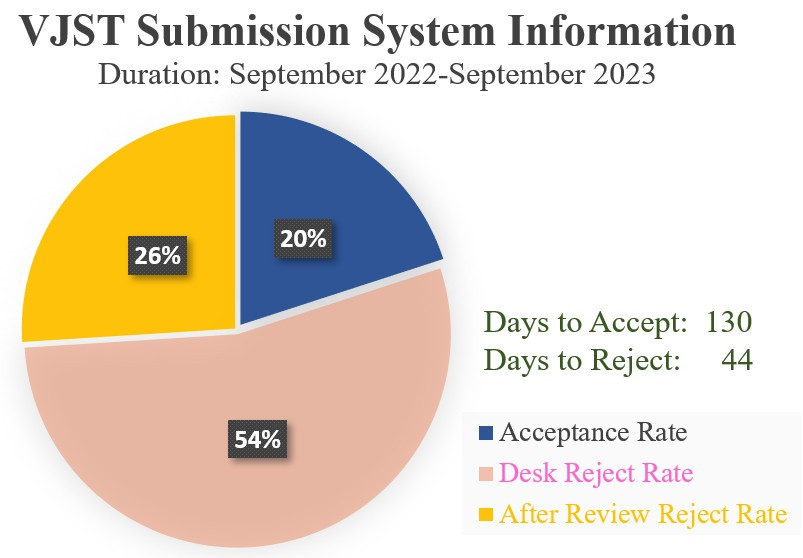
 Vietnam Journal of Science and Technology (VJST) is pleased to notice: