Stress analysis of anisotropic hybrid composite plates with loaded holes
Author affiliations
DOI:
https://doi.org/10.15625/0866-7136/23885Keywords:
anisotropic hybrid composite, loaded hole, boundary-based finite element method, pressurized hole, interference fitAbstract
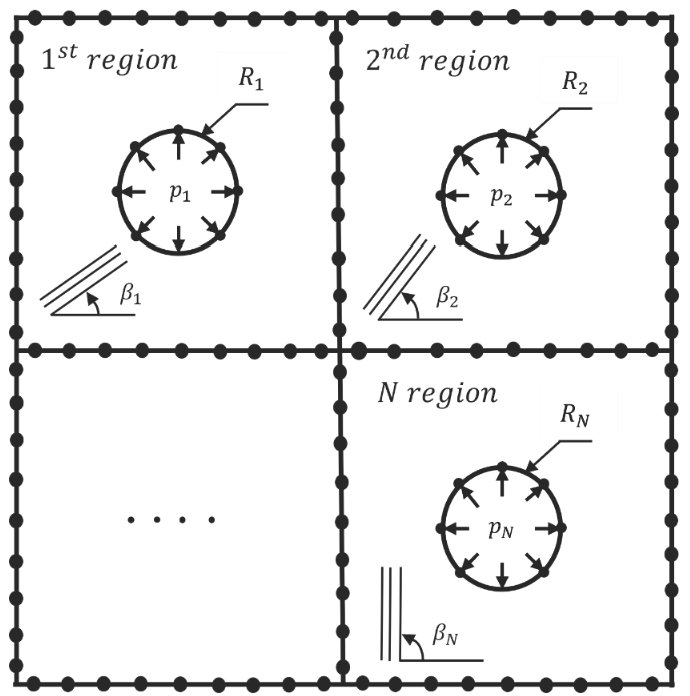
In this paper, a stress analysis of hybrid anisotropic composite plates with loaded holes is performed using the boundary-based finite element method (BFEM). Here, the hybrid composite plates may consist of different anisotropic elastic materials. To apply the BFEM, we divide the plate into different regions, each of which is made of different anisotropic elastic constants. The BFEM combines the boundary elements in each region into a single finite element and assembles them following the rules of the finite element method. This method, therefore, does not require volumetric meshing, which is beneficial for meshing and computational costs. The BFEM can be applied to general anisotropic hybrid elastic plates and various loaded hole situations, e.g., pressurized holes or prescribed displacements on the holes. With the BFEM, numerical examples are performed. The numerical results will be used for verification and parametric study purposes. In the verification, we compare the results obtained by the BFEM with those obtained by other available solution methods. The parametric studies investigate the effects of the anisotropic material properties and applied pressurized loads/displacements on the stress distribution around the hole.
Downloads
References
Abazadeh, B., & Shishevan, F. A. (2019). An estimation of fatigue crack initiation and growth lives of Al 2024-T3 in double lap bolted joints with interference fitted holes. Engineering Failure Analysis, 105, 1018–1031. https://doi.org/10.1016/j.engfailanal.2019.07.054
Bahloul, A., Mhalla, M. M., & Bouraoui, C. (2018). Crack repair of SENT specimen using the interference fit process. Journal of Alloys and Compounds, 748, 363–374. https://doi.org/10.1016/j.jallcom.2018.03.142
Bi, Y., Jiang, J., & Ke, Y. (2015). Effect of interference fit size on local stress in single lap bolted joints. Advances in Mechanical Engineering, 7(6), 168781401559030. https://doi.org/10.1177/1687814015590307
Chen, Y. C., & Hwu, C. (2014). Boundary element method for vibration analysis of two-dimensional anisotropic elastic solids containing holes, cracks or interfaces. Engineering Analysis with Boundary Elements, 40, 22–35. https://doi.org/10.1016/j.enganabound.2013.11.013
Hwu, C., Huang, S. T., & Li, C. C. (2017). Boundary-based finite element method for two-dimensional anisotropic elastic solids with multiple holes and cracks. Engineering Analysis with Boundary Elements, 79, 13–22. https://doi.org/10.1016/j.enganabound.2017.03.003
Hwu, C. (2021). Anisotropic Elasticity with MATLAB. Springer.
Jamir, M. R. M., Majid, M. S. A., Khasri, A., Jawaid, M., & Thariq, M. (2018). Natural lightweight hybrid composites for aircraft structural applications. Sustainable Composites for Aerospace Applications, 155–170. https://doi.org/10.1016/B978-0-08-102131-6.00008-6
Li, Y., Zhang, K. F., Liu, P., & Zou, P. (2015). Interface damage behaviour during interference-fit bolt installation process for CFRP/Ti alloy joining structure. Fatigue & Fracture of Engineering Materials & Structures, 38, 1359–1371. https://doi.org/10.1111/ffe.12313
Lie, S. T., Yu, G., & Zhao, Z. (2000). Analysis of mechanically fastened composite joints by boundary element methods. Composites Part B: Engineering, 31(8), 693–705. https://doi.org/10.1016/S1359-8368(00)00039-1
Nguyen, V. T., & Hwu, C. (2017). Holes, cracks, or inclusions in two-dimensional linear anisotropic viscoelastic solids. Composites Part B: Engineering, 117, 111–123. https://doi.org/10.1016/j.compositesb.2017.01.050
Nguyen, V. T., & Hwu, C. (2018). Multiple holes, cracks, and inclusions in anisotropic viscoelastic solids. Mechanics of Time-Dependent Materials, 22, 187–205. https://doi.org/10.1007/s11043-017-9349-9
Nguyen, H. Q., Nguyen, V. T., Nguyen, C. M., & Nguyen, T. K. H. (2025). A linear superposition method for pressurized holes/cracks in 2D anisotropic elastic solids. International Journal of Applied Mechanics, 17(6), 2550043. https://doi.org/10.1142/S1758825125500437
Nguyen, V. T., Nguyen, T. K. H., & Nguyen, C. M. (2025). Semi-analytical method for pin-loaded joint contact in anisotropic piezoelectric plates. International Journal of Mechanical Sciences, 288, 110001. https://doi.org/10.1016/j.ijmecsci.2025.110001
Nguyen-Hoang, M., & Becker, W. (2022). Open holes in composite laminates with finite dimensions: structural assessment by analytical methods. Archive of Applied Mechanics, 92, 1101–1125. https://doi.org/10.1007/s00419-021-02095-w
Pham, T., & Weijermars, R. (2020). Solving stress tensor fields around multiple pressure-loaded fractures using a linear superposition method (LSM). Applied Mathematical Modelling, 88, 418–436. https://doi.org/10.1016/j.apm.2020.06.041
Puttegowda, M., Rangappa, S. M., Jawaid, M., Shivanna, P., Basavegowda, Y., Saba, N., & Thariq, M. (2018). Potential of natural/synthetic hybrid composites for aerospace applications. Sustainable Composites for Aerospace Applications, 315–351. https://doi.org/10.1016/B978-0-08-102131-6.00021-9
Rust, W. (2015). Non-Linear Finite Element Analysis in Structural Mechanics. Springer.
Song, D., Li, Y., Zhang, K., Cheng, H., Liu, P., & Hu, J. (2016). Micromechanical analysis for microscopic damage initiation in fiber/epoxy composite during interference-fit pin installation. Materials & Design, 89, 36–49. https://doi.org/10.1016/j.matdes.2015.09.118
Toubal, L., Karama, M., & Lorrain, B. (2005). Stress concentration in a circular hole in composite plate. Composite Structures, 68(1), 31–36. https://doi.org/10.1016/j.compstruct.2004.02.016
Wang, A., Wang, Z., Zhao, M., Zhao, Y., & Chang, Z. (2023). Effects of ply thickness and interference-fit on the bearing strength of single-lap countersunk composite joints. Thin-Walled Structures, 189, 110878. https://doi.org/10.1016/j.tws.2023.110878
Weijermars, R., Pham, T., & Ettehad, M. (2020). Linear superposition method (LSM) for solving stress tensor fields and displacement vector fields: Application to multiple pressure-loaded circular holes in an elastic plate with far-field stress. Applied Mathematics and Computation, 381, 125234. https://doi.org/10.1016/j.amc.2020.125234
Wintermantel, E., Mayer, J., Goehring, T. N., Buschow, K. H. J., Cahn, R. W., Flemings, M. C., Ilschner, B., Kramer, E. J., Mahajan, S., & Veyssìere, P. (2001). Composites for biomedical applications. Encyclopedia of Materials: Science and Technology, 1371–1376. https://doi.org/10.1016/B0-08-043152-6/00255-2
Wu, H. C., & Mu, B. (2003). On stress concentrations for isotropic/orthotropic plates and cylinders with a circular hole. Composites Part B: Engineering, 34(2), 127–134. https://doi.org/10.1016/S1359-8368(02)00097-5
Xu, G., Cheng, H., Zhang, K., Liang, B., Cheng, Y., Hu, J., & Liu, C. (2020). Modeling of damage behavior of carbon fiber reinforced plastic composites interference bolting with sleeve. Materials & Design, 194, 108904. https://doi.org/10.1016/j.matdes.2020.108904
Zhang, Y., & Zhou, Z. (2022). Experimental and multiscale numerical investigation on failure behavior of satin woven carbon/carbon composites subjected to pin-loading. International Journal of Mechanical Sciences, 219, 107129. https://doi.org/10.1016/j.ijmecsci.2022.107129
Zuo, Y., Cao, Z., Zheng, G., & Zhang, Q. (2020). Damage behavior investigation of CFRP/Ti bolted joint during interference fit bolt dynamic installation progress. Engineering Failure Analysis, 111, 104454. https://doi.org/10.1016/j.engfailanal.2020.104454
Downloads
Published
How to Cite
License

This work is licensed under a Creative Commons Attribution-ShareAlike 4.0 International License.




Funding data
-
Quỹ Đổi mới sáng tạo Vingroup
Grant numbers VINIF.2024.ThS.07