Particle shape effect of granular column collapse on an erodible bed: A superquadric DEM study
Author affiliations
DOI:
https://doi.org/10.15625/0866-7136/23723Keywords:
erosion mechanism, erodible bed, granular collapse, particle shape, runout distanceAbstract
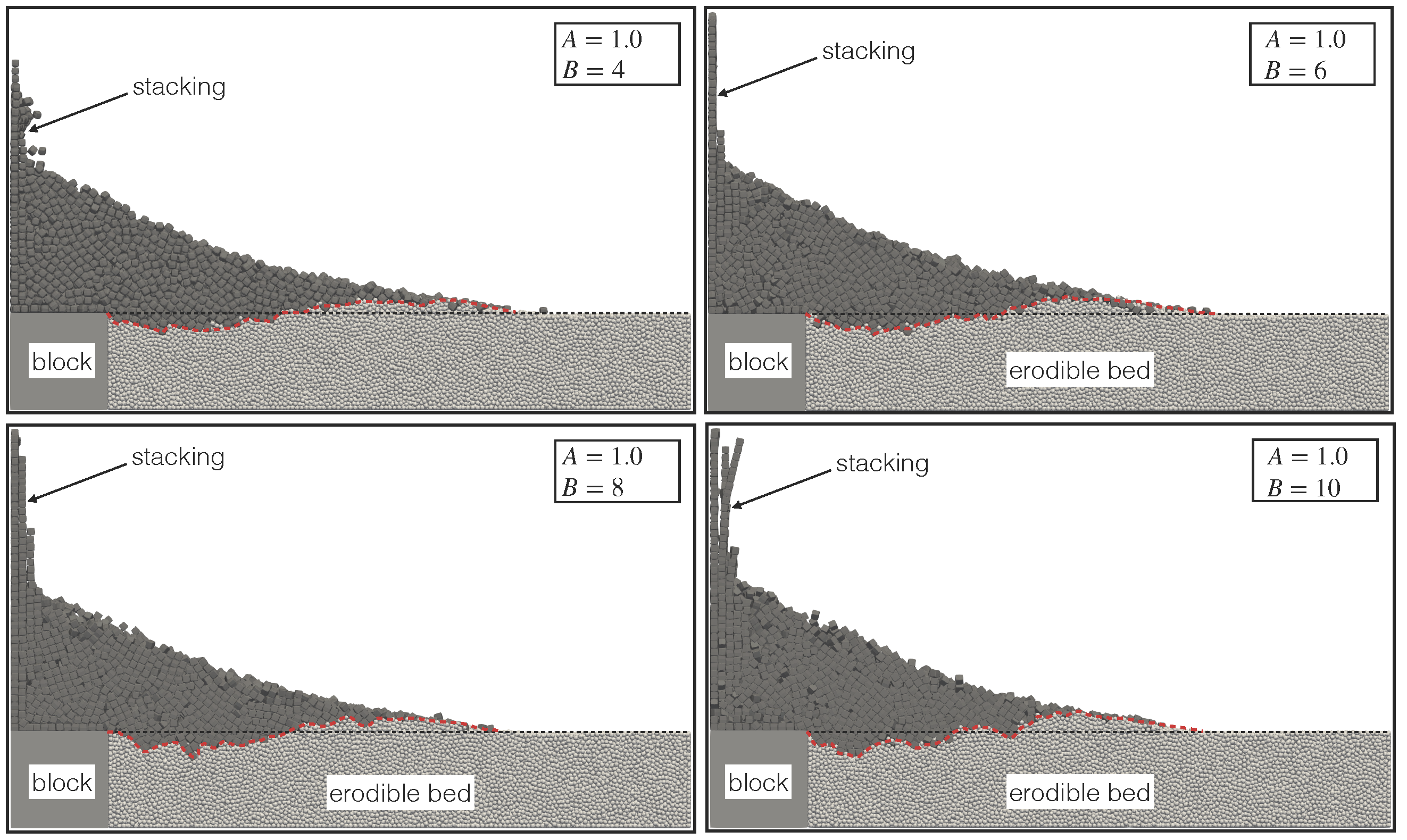
Granular flows are common phenomena observed in natural disasters such as landslides and rock avalanches. These geophysical mass flows commonly exhibit inherently complex behavior due to the interplay of multiple impact factors, especially the particle shape effect and the underlying erodible bed. In this work, we systematically study the effects of particle shape on granular column collapse on an erodible bed using the superquadric discrete element simulations. The non-spherical particle shapes are accurately defined utilizing the aspect ratio A and blockiness B, resulting in a change from elongated to platy and cubic shapes. The granular column is composed of different superquadric grains; meanwhile, the erodible bed is kept constant in a weak binary-size mixture of spherical grains for simply describing and quantifying the erosion behavior of erodible grains. The results show that the degrees of erosion slightly increase with decreasing elongation of superquadric grains. The runout distance of the granular columns changes complicatedly with the increase of the particle aspect ratio, while it declines significantly with increasing blockiness. The blockiness of superquadric grains also reveals significant impacts on the erosion behavior of granular materials. These findings may improve the understanding of more general scenarios of granular mass flows on complex surfaces such as an erodible bed.
Downloads
References
Banerjee, S. K., Yang, M., & Taiebat, M. (2024). Effect of particle shape on cyclic liquefaction resistance of granular materials. Acta Geotechnica, 19, 4503–4518. https://doi.org/10.1007/s11440-023-02169-9
Barr, A. H. (1981). Superquadrics and angle-preserving transformations. IEEE Computer Graphics and Applications, 1(1), 11–23. https://doi.org/10.1109/MCG.1981.1673799
Chou, S. H., Yang, S. J., & Hsiau, S. S. (2023). Investigation on the erosion and deposition process of granular collapse flow on an erodible inclined plane. Powder Technology, 414, 118086. https://doi.org/10.1016/j.powtec.2022.118086
Crosta, G. B., Imposimato, S., & Roddeman, D. (2009). Numerical modeling of 2-D granular step collapse on erodible and nonerodible surface. Journal of Geophysical Research: Earth Surface, 114(F3). https://doi.org/10.1029/2008jf001186
He, X., Hu, X., Huo, Z., Tang, J., & Zhang, S. (2024). Study on dynamic mechanism of granular flow erosion and entrainment based on DEM theory. Geoenvironmental Disasters, 11, 17. https://doi.org/10.1186/s40677-024-00278-5
Hoang, U. T., & Nguyen, N. H. T. (2023). Particle shape effects on granular column collapse using superquadric DEM. Powder Technology, 424, 118559. https://doi.org/10.1016/j.powtec.2023.118559
Kloss, C., & Goniva, C. (2011). LIGGGHTS -- Open Source Discrete Element Simulations of Granular Materials Based on LAMMPS. Supplemental Proceedings: Materials Fabrication, Properties, Characterization, and Modeling, 781–788. https://doi.org/10.1002/9781118062142.ch94
Lajeunesse, E., Monnier, J. B., & Homsy, G. M. (2005). Granular slumping on a horizontal surface. Physics of Fluids, 17(10), 103302. https://doi.org/10.1063/1.2087687
Ligneau, C., Sovilla, B., & Gaume, J. (2024). Modelling erosion, entrainment and deposition in cohesive granular flows: Application to dense snow avalanches. Cold Regions Science and Technology, 219, 104103. https://doi.org/10.1016/j.coldregions.2023.104103
Lube, G., Huppert, H. E., Sparks, R. S. J., & Freundt, A. (2005). Collapses of two-dimensional granular columns. Physical Review E, 72(4), 041301. https://doi.org/10.1103/physreve.72.041301
Man, T., Huppert, H. E., Li, L., & Galindo-Torres, S. A. (2021). Deposition morphology of granular column collapses. Granular Matter, 23(3), 59. https://doi.org/10.1007/s10035-021-01112-7
Man, T., Zhang, Z., Huppert, H. E., & Galindo-Torres, S. A. (2023). Axisymmetric column collapses of bi-frictional granular mixtures. Journal of Fluid Mechanics, 963. https://doi.org/10.1017/jfm.2023.217
Mangeney, A., Roche, O., Hungr, O., Mangold, N., Faccanoni, G., & Lucas, A. (2010). Erosion and mobility in granular collapse over sloping beds. Journal of Geophysical Research: Earth Surface, 115(F3). https://doi.org/10.1029/2009jf001462
Nguyen, N. H. T., Bui, H. H., & Nguyen, G. D. (2020). Effects of material properties on the mobility of granular flow. Granular Matter, 22(3), 59. https://doi.org/10.1007/s10035-020-01024-y
Nguyen, T., & Vo, T. (2025). Unified power-law scaling behavior of collapse mobility and deposition morphology of granular columns composed of frictional-pentagonal grains. Granular Matter, 27(4), 110. https://doi.org/10.1007/s10035-025-01586-9
Ouyang, C., He, S., & Tang, C. (2015). Numerical analysis of dynamics of debris flow over erodible beds in Wenchuan earthquake-induced area. Engineering Geology, 194, 62–72. https://doi.org/10.1016/j.enggeo.2014.07.012
Pudasaini, S. P., & Krautblatter, M. (2021). The mechanics of landslide mobility with erosion. Nature Communications, 12, 6793. https://doi.org/10.1038/s41467-021-26959-5
Vo, T., & Nguyen, T. (2024). Collapse dynamics and deposition morphology of low-viscocohesive granular columns on a rough horizontal surface. Physical Review E, 109(1), 014904. https://doi.org/10.1103/physreve.109.014904
Vo, T., Dinh Minh, T., Nguyen, N. H. T., Nguyen, T., & Bui, T. Q. (2024). Scaling behavior of granular columns collapse on erodible-inclined surfaces. Powder Technology, 433, 119274. https://doi.org/10.1016/j.powtec.2023.119274
Vo, T., & Nguyen, T. (2025). Combined effect of particle shape and interparticle friction on the collapse mobility and deposition morphology of a granular column. International Journal for Numerical and Analytical Methods in Geomechanics, 50(3), 1412–1429. https://doi.org/10.1002/nag.70174
Wu, Y., Li, P., & Wang, D. (2018). Erosion-deposition regime formation in granular column collapse over an erodible surface. Physical Review E, 98(5), 052909. https://doi.org/10.1103/physreve.98.052909
Wu, Y., Wang, D., & Li, P. (2021). The collapse of a granular column onto an erodible bed: dynamics and morphology scaling. Granular Matter, 23(2), 31. https://doi.org/10.1007/s10035-021-01100-x
Downloads
Published
How to Cite
License

This work is licensed under a Creative Commons Attribution-ShareAlike 4.0 International License.




Funding data
-
National Foundation for Science and Technology Development
Grant numbers 107.01-2025.106