Nonlinear free vibration analysis of ultra-thin organic solar plates
Author affiliations
DOI:
https://doi.org/10.15625/0866-7136/23709Keywords:
nonlinear free vibration, ultra-thin organic solar cells, refined higher-order shear deformation theory, isogeometric analysisAbstract
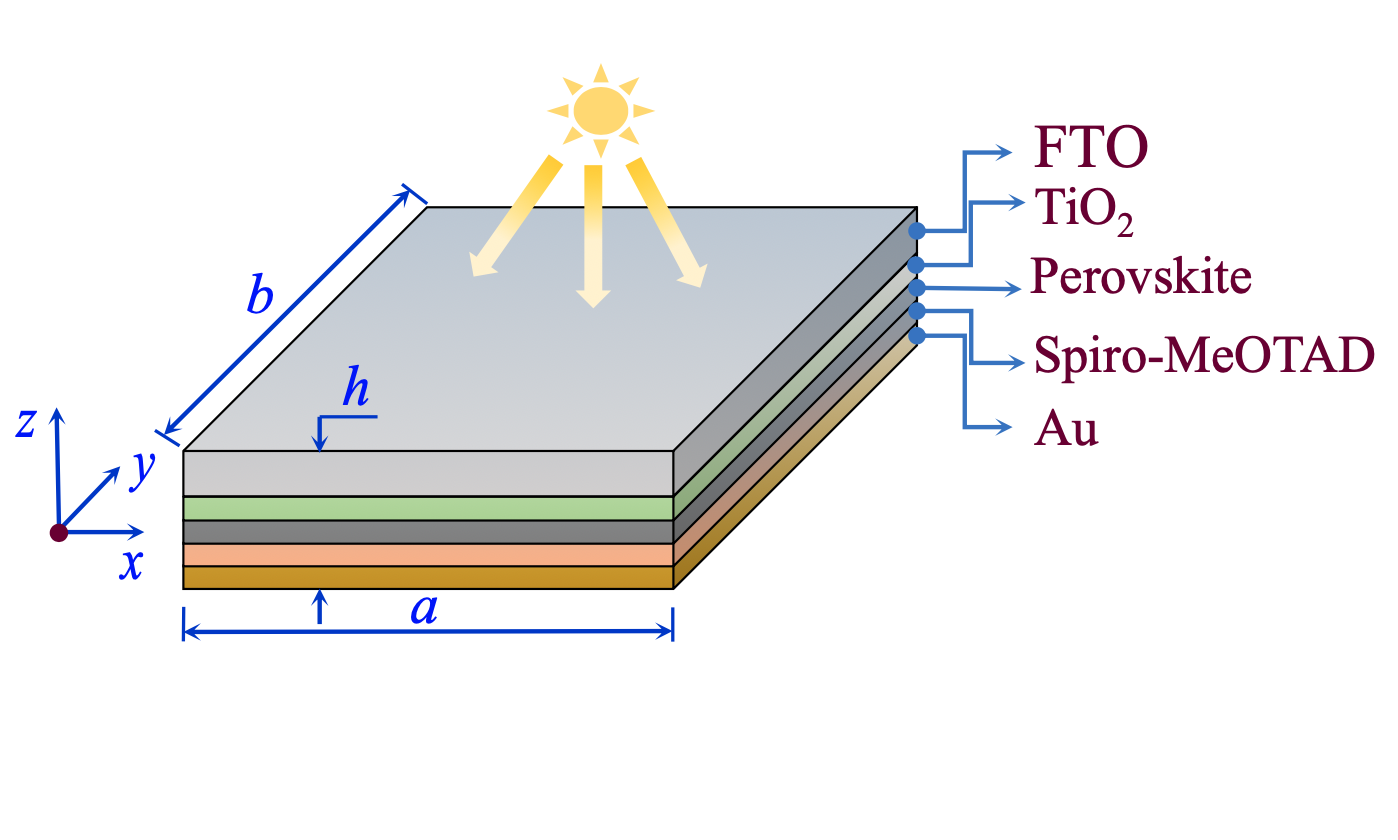
Organic photovoltaic devices have gained significant attention as promising solutions to global energy challenges, owing to their unique advantages, including lightweight construction, optical transparency, mechanical flexibility, and low production cost. In this context, the present work aims to introduce an efficient computational approach to investigate the nonlinear free vibration characteristics of ultra-thin organic solar panels. To this end, the solar panel structure is modeled as a multilayered plate, in which each functional layer is assumed to be isotropic. The fundamental displacements are formulated using a refined higher-order shear deformation theory with four independent variables, combined with the von Kármán nonlinear strain assumption to capture large-amplitude effects. The nonlinear natural frequencies are subsequently determined using the non-uniform rational B-splines (NURBS)-based isogeometric analysis (IGA) in conjunction with an iterative displacement-control scheme. Several benchmark investigations are performed to validate the accuracy and robustness of the present formulation. Furthermore, the effects of several key factors, including boundary conditions, length-to-thickness ratios, and aspect dimensions, on the nonlinear vibration characteristics is comprehensively investigated in this work. Several significant remarks are drawn to support the design and optimization of ultra-thin organic solar plate structures in practical engineering applications.
Downloads
References
Anh, V. M., Quan, T. Q., & Tran, P. (2021). Nonlinear vibration and geometric optimization of nanocomposite multilayer organic solar cell under wind loading. Thin-Walled Structures, 158, 107199. https://doi.org/10.1016/j.tws.2020.107199
Bartesaghi, D., & Koster, L. J. A. (2015). The effect of large compositional inhomogeneities on the performance of organic solar cells: A numerical study. Advanced Functional Materials, 25(13), 2013–2023. https://doi.org/10.1002/adfm.201402260
Cardinaletti, I., Vangerven, T., Nagels, S., Cornelissen, R., Schreurs, D., Hruby, J., Vodnik, J., Devisscher, D., Kesters, J., D’Haen, J., Franquet, A., Spampinato, V., Conard, T., Maes, W., Deferme, W., & Manca, J. V. (2018). Organic and perovskite solar cells for space applications. Solar Energy Materials and Solar Cells, 182, 121–127. https://doi.org/10.1016/j.solmat.2018.03.024
Chen, L. X. (2019). Organic solar cells: Recent progress and challenges. ACS Energy Letters, 4(10), 2537–2539. https://doi.org/10.1021/acsenergylett.9b02071
Chung, N. T., & Thu, D. T. N. (2023). Static stability study of stiffened functionally graded composite plates reinforced by carbon nanotubes using finite element method. Vietnam Journal of Mechanics, 45(3), 216–234. https://doi.org/10.15625/0866-7136/18862
Cottrell, J. A., Hughes, T. J. R., & Bazilevs, Y. (2009). Isogeometric analysis: toward integration of CAD and FEA. John Wiley & Sons. https://doi.org/10.1002/9780470749081
Do, D. T. T., Nguyen, A. T., & Nguyen, N. V. (2024). An isogeometric approach of static, free vibration and buckling analyses of multilayered solar cell structures. International Journal of Mechanics and Materials in Design, 20(3), 463–479.
Duc, N. D., Seung-Eock, K., Quan, T. Q., Long, D. D., & Anh, V. M. (2018). Nonlinear dynamic response and vibration of nanocomposite multilayer organic solar cell. Composite Structures, 184, 1137–1144. https://doi.org/10.1016/j.compstruct.2017.10.064
Guo, H., Yuan, J., & Zur, K. K. (2024). Flutter and divergence zones of perovskite solar cell-based panels of aircraft wings in subsonic airflow. Aerospace Science and Technology, 145, 108841. https://doi.org/10.1016/j.ast.2023.108841
Gupta, V., Jameel, A., Verma, S. K., Anand, S., & Anand, Y. (2023). An insight on NURBS based isogeometric analysis, its current status and involvement in mechanical applications. Archives of Computational Methods in Engineering, 30(2), 1187–1230. https://doi.org/10.1007/s11831-022-09838-0
Han, W., & Petyt, M. (1997). Geometrically nonlinear vibration analysis of thin, rectangular plates using the hierarchical finite element method—I: The fundamental mode of isotropic plates. Computers & Structures, 63(2), 295–308. https://doi.org/10.1016/s0045-7949(96)00345-8
Hughes, T. J. R., Cottrell, J. A., & Bazilevs, Y. (2005). Isogeometric analysis: CAD, finite elements, NURBS, exact geometry and mesh refinement. Computer Methods in Applied Mechanics and Engineering, 194(39–41), 4135–4195. https://doi.org/10.1016/j.cma.2004.10.008
Kumavat, P. P., Sonar, P., & Dalal, D. S. (2017). An overview on basics of organic and dye sensitized solar cells, their mechanism and recent improvements. Renewable and Sustainable Energy Reviews, 78, 1262–1287. https://doi.org/10.1016/j.rser.2017.05.011
Li, Q., Wang, Q., Wu, D., Chen, X., Yu, Y., & Gao, W. (2019). Geometrically nonlinear dynamic analysis of organic solar cell resting on Winkler-Pasternak elastic foundation under thermal environment. Composites Part B: Engineering, 163, 121–129. https://doi.org/10.1016/j.compositesb.2018.11.022
Li, Q., Wu, D., Gao, W., Tin-Loi, F., Liu, Z., & Cheng, J. (2019). Static bending and free vibration of organic solar cell resting on Winkler-Pasternak elastic foundation through the modified strain gradient theory. European Journal of Mechanics - A/Solids, 78, 103852. https://doi.org/10.1016/j.euromechsol.2019.103852
Li, Q., Wu, D., Gao, W., & Tin-Loi, F. (2020). Size-dependent instability of organic solar cell resting on Winkler--Pasternak elastic foundation based on the modified strain gradient theory. International Journal of Mechanical Sciences, 177, 105306. https://doi.org/10.1016/j.ijmecsci.2019.105306
Li, Q., Tian, Y., Wu, D., Gao, W., Yu, Y., Chen, X., & Yang, C. (2021). The nonlinear dynamic buckling behaviour of imperfect solar cells subjected to impact load. Thin-Walled Structures, 169, 108317. https://doi.org/10.1016/j.tws.2021.108317
Li, D., & Liu, W. (2023). Vibration control for the solar panels of spacecraft: Innovation methods and potential approaches. International Journal of Mechanical System Dynamics, 3(4), 300–330. https://doi.org/10.1002/msd2.12094
Mahmood, A., & Wang, J. (2021). Machine learning for high performance organic solar cells: current scenario and future prospects. Energy & Environmental Science, 14(1), 90–105. https://doi.org/10.1039/d0ee02838j
Meng, L., Zhang, Y., Wan, X., Li, C., Zhang, X., Wang, Y., Ke, X., Xiao, Z., Ding, L., Xia, R., Yip, H., Cao, Y., & Chen, Y. (2018). Organic and solution-processed tandem solar cells with 17.3% efficiency. Science, 361(6407), 1094–1098. https://doi.org/10.1126/science.aat2612
Mirzaei, M., & Kiani, Y. (2016). Nonlinear free vibration of temperature-dependent sandwich beams with carbon nanotube-reinforced face sheets. Acta Mechanica, 227(7), 1869–1884. https://doi.org/10.1007/s00707-016-1593-6
Mohammadzadeh-Keleshteri, M., Asadi, H., & Aghdam, M. (2017). Geometrical nonlinear free vibration responses of FG-CNT reinforced composite annular sector plates integrated with piezoelectric layers. Composite Structures, 171, 100–112. https://doi.org/10.1016/j.compstruct.2017.01.048
Nguyen, H. X., Atroshchenko, E., Nguyen-Xuan, H., & Vo, T. P. (2017). Geometrically nonlinear isogeometric analysis of functionally graded microplates with the modified couple stress theory. Computers & Structures, 193, 110–127. https://doi.org/10.1016/j.compstruc.2017.07.017
Nguyen, N. V., & Phan, D. (2023). Nonlinear free vibration of bi-directional functionally graded porous plates. Thin-Walled Structures, 192, 111198. https://doi.org/10.1016/j.tws.2023.111198
Nguyen, N. V. (2025). A four-variable isogeometric approach for flutter analysis of ultra-thin perovskite solar structures. Materials and Emerging Technologies for Sustainability, 01(03), 2550014. https://doi.org/10.1142/s3060932125500141
Nguyen, N. V., Tran, K. Q., Fantuzzi, N., & Nguyen-Xuan, H. (2025). A size-dependent nonlinear analysis of perovskite solar panels with FG-CNTR-TPMS substrates. Composite Structures, 351, 118548. https://doi.org/10.1016/j.compstruct.2024.118548
Nguyen, N. V., Żur, K. K., & Nguyen-Xuan, H. (2025). Supersonic flutter characteristics of perovskite solar panels integrated into nature-inspired structures. Thin-Walled Structures, 214, 113358. https://doi.org/10.1016/j.tws.2025.113358
Nguyen-Xuan, H., Tran, L. V., Thai, C. H., Kulasegaram, S., & Bordas, S. P. A. (2014). Isogeometric analysis of functionally graded plates using a refined plate theory. Composites Part B: Engineering, 64, 222–234. https://doi.org/10.1016/j.compositesb.2014.04.001
Razavi, S., & Shooshtari, A. (2015). Nonlinear free vibration of magneto-electro-elastic rectangular plates. Composite Structures, 119, 377–384. https://doi.org/10.1016/j.compstruct.2014.08.034
Reddy, J. N. (2003). Mechanics of laminated composite plates and shells: theory and analysis. CRC press.
Senthilnathan, N. R., Lim, S. P., Lee, K. H., & Chow, S. T. (1987). Buckling of shear-deformable plates. AIAA journal, 25(9), 1268–1271. https://doi.org/10.2514/3.48742
Shen, H., & Li, C. (2023). Modeling and evaluation for large amplitude vibration and nonlinear bending of perovskite solar cell. Composite Structures, 303, 116235. https://doi.org/10.1016/j.compstruct.2022.116235
Tao, C., & Dai, T. (2021). Isogeometric analysis for size-dependent nonlinear free vibration of graphene platelet reinforced laminated annular sector microplates. European Journal of Mechanics - A/Solids, 86, 104171. https://doi.org/10.1016/j.euromechsol.2020.104171
Thai, C. H., & Nguyen-Xuan, H. (2020). A simple size-dependent isogeometric approach for bending analysis of functionally graded microplates using the modified strain gradient elasticity theory. Vietnam Journal of Mechanics, 42(3), 255–267. https://doi.org/10.15625/0866-7136/15372
Tran, L. V., Thai, C. H., Le, H. T., Gan, B. S., Lee, J., & Nguyen-Xuan, H. (2014). Isogeometric analysis of laminated composite plates based on a four-variable refined plate theory. Engineering Analysis with Boundary Elements, 47, 68–81. https://doi.org/10.1016/j.enganabound.2014.05.013
Tran, H. D., & Nguyen, B. H. (2017). An isogeometric SGBEM for crack problems of magneto-electro-elastic materials. Vietnam Journal of Mechanics, 39(2), 135–147. https://doi.org/10.15625/0866-7136/8691
Xiong, C., Sun, J., Yang, H., & Jiang, H. (2019). Real reason for high ideality factor in organic solar cells: Energy disorder. Solar Energy, 178, 193–200. https://doi.org/10.1016/j.solener.2018.11.067
Zhu, C., Yuan, J., Cai, F., Meng, L., Zhang, H., Chen, H., Li, J., Qiu, B., Peng, H., Chen, S., Hu, Y., Yang, C., Gao, F., Zou, Y., & Li, Y. (2020). Tuning the electron-deficient core of a non-fullerene acceptor to achieve over 17% efficiency in a single-junction organic solar cell. Energy & Environmental Science, 13(8), 2459–2466. https://doi.org/10.1039/d0ee00862a
Downloads
Published
How to Cite
Issue
Section
Categories
License

This work is licensed under a Creative Commons Attribution-ShareAlike 4.0 International License.




Funding data
-
National Foundation for Science and Technology Development
Grant numbers 107.02-2023.27