Integrating reaction-diffusion equations with a dynamic body-fitted trimmed mesh technique for level set-based structural optimization
Author affiliations
DOI:
https://doi.org/10.15625/0866-7136/22420Keywords:
body-fitted trimmed mesh, level set function, reaction-diffusion equation, marching square algorithm, exact volume constraint methodAbstract
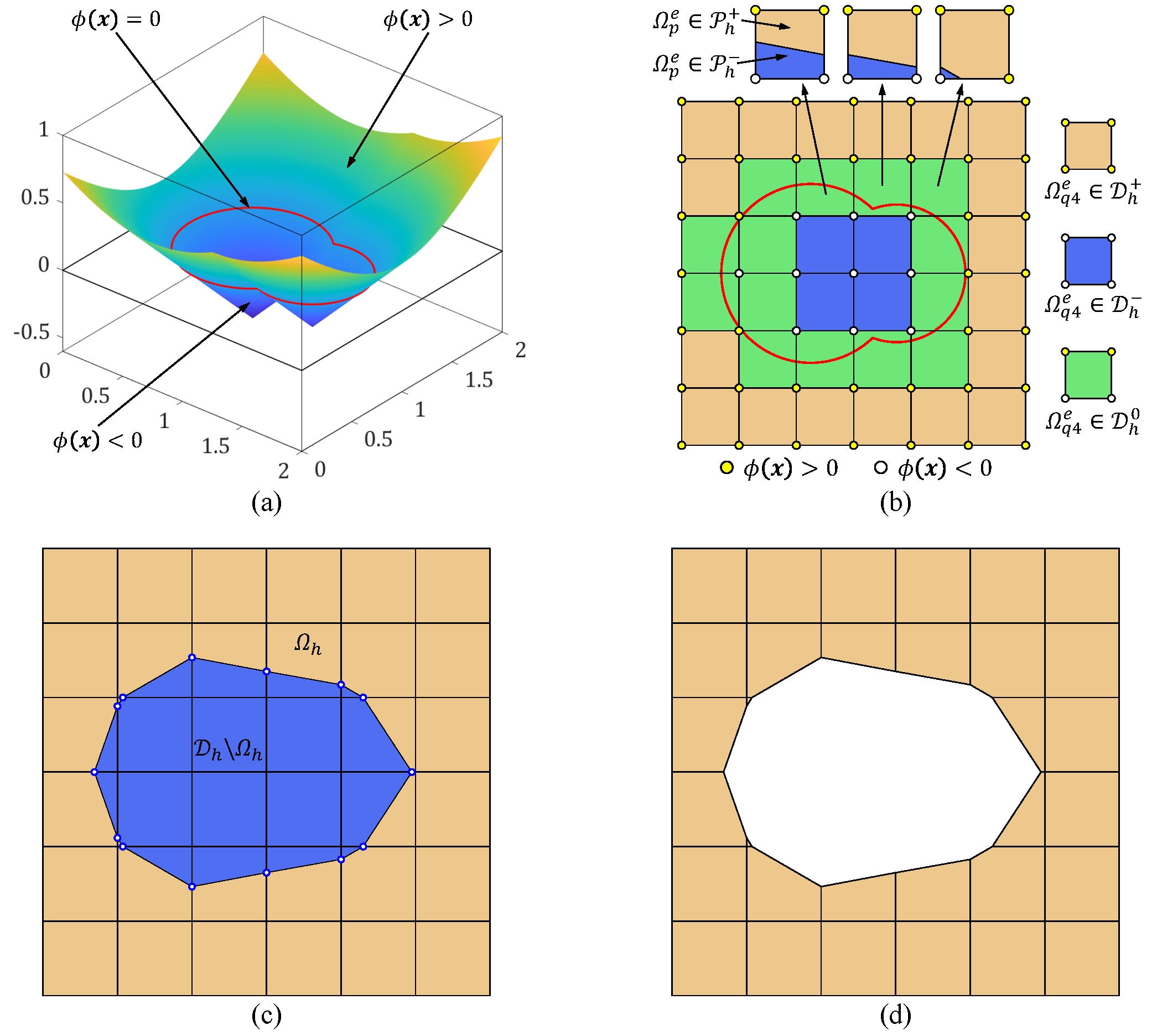
In this study, a dynamic body-fitted trimmed mesh approach is presented to address reaction-diffusion equation-based topology optimization problems, with the objective of minimizing structural compliance. The evolution of the zero-isoline of a level set function is governed by the solution of a reaction-diffusion equation, which is controlled by the topological sensitivity field and implemented on a regular background quadrilateral mesh. During each optimization iteration, a dynamic body-fitted trimmed mesh is constructed to accurately delineate the structural domain. This procedure employs the marching square algorithm, which segments the fixed background quadrilateral mesh along the zero-isoline of the level set function. To ensure precision in the optimization, the reaction-diffusion equation is solved utilizing a numerical algorithm grounded in the exact volume constraint method, which meticulously calculates the Lagrange multiplier to uphold the constraint condition. The proposed approach exhibits exceptional efficacy in solving level set-based topology optimization challenges, particularly in achieving accurate boundary representations while strictly adhering to volume constraint conditions within a predefined error tolerance. These are evident through the numerical results of two benchmark problems including 2D cantilever beam and L-bracket domain.
Downloads
References
[1] Z. Zhuang, F. Xu, J. Ye, W. Tong, Z. Chen, and Y. Weng. A 262-line Matlab code for the level set topology optimization based on the estimated gradient field in the body-fitted mesh. Structural and Multidisciplinary Optimization, 67, (2024). https://doi.org/10.1007/s00158-024-03891-y.
[2] P. Wei, Z. Li, X. Li, and M. Y. Wang. An 88-line MATLAB code for the parameterized level set method based topology optimization using radial basis functions. Structural and Multidisciplinary Optimization, 58, (2018), pp. 831–849. https://doi.org/10.1007/s00158-018-1904-8.
[3] M. Cui, M. Pan, J. Wang, and P. Li. A parameterized level set method for structural topology optimization based on reaction diffusion equation and fuzzy PID control algorithm. Electronic Research Archive, 30, (7), (2022), pp. 2568–2599. https://doi.org/10.3934/era.2022132.
[4] T. Yamada, K. Izui, S. Nishiwaki, and A. Takezawa. A topology optimization method based on the level set method incorporating a fictitious interface energy. Computer Methods in Applied Mechanics and Engineering, 199, (2010), pp. 2876–2891. https://doi.org/10.1016/j.cma.2010.05.013.
[5] M. Otomori, T. Yamada, K. Izui, and S. Nishiwaki. Matlab code for a level set-based topology optimization method using a reaction diffusion equation. Structural and Multidisciplinary Optimization, 51, (2015), pp. 1159–1172. https://doi.org/10.1007/s00158-014-1190-z.
[6] G. Allaire, F. Jouve, and A. M. Toader. Structural optimization using sensitivity analysis and a level-set method. Journal of Computational Physics, 194, (2004), pp. 363–393. https://doi.org/10.1016/j.jcp.2003.09.032.
[7] M. P. Bendsøe and O. Sigmund. Topology optimization, theory, methods and applications. Springer Berlin Heidelberg, Berlin, Heidelberg, 2nd edition, (2004). https://doi.org/10.1007/978-3-662-05086-6.
[8] Y. M. Xie and G. P. Steven. Evolutionary structural optimization. Springer London, London, New York, (1997). https://doi.org/10.1007/978-1-4471-0985-3.
[9] K. Abe, S. Kazama, and K. Koro. A boundary element approach for topology optimization problem using the level set method. Communications in Numerical Methods in Engineering, 23, (2007), pp. 405–416. https://doi.org/10.1002/cnm.919.
[10] K. E. Jensen. Solving stress and compliance constrained volume minimization using anisotropic mesh adaptation, the method of moving asymptotes and a global p-norm. Structural and Multidisciplinary Optimization, 54, (2016), pp. 831–841. https://doi.org/10.1007/s00158-016-1439-9.
[11] S. H. Nguyen and H. G. Kim. Level set based shape optimization using trimmed hexahedral meshes. Computer Methods in Applied Mechanics and Engineering, 345, (2019), pp. 555–583. https://doi.org/10.1016/j.cma.2018.11.006.
[12] S. H. Nguyen and H.-G. Kim. Stress-constrained shape and topology optimization with the level set method using trimmed hexahedral meshes. Computer Methods in Applied Mechanics and Engineering, 366, (2020). https://doi.org/10.1016/j.cma.2020.113061.
[13] T. Ho-Nguyen-Tan and H.-G. Kim. Level set-based topology optimization for compliance and stress minimization of shell structures using trimmed quadrilateral shell meshes. Computers & Structures, 259, (2022). https://doi.org/10.1016/j.compstruc.2021.106695.
[14] J. J. Laguardia, E. Cueto, and M. Doblaré. A natural neighbour Galerkin method with quadtree structure. International Journal for Numerical Methods in Engineering, 63, (6), (2005), pp. 789–812. https://doi.org/10.1002/nme.1297.
[15] Y. Cui, T. Takahashi, and T. Matsumoto. An exact volume constraint method for topology optimization via reaction–diffusion equation. Computers & Structures, 280, (2023). https://doi.org/10.1016/j.compstruc.2023.106986.
[16] E. L. Wachspress. A rational finite element basis. Academic Press, New York, (1975).
[17] D. Adalsteinsson and J. A. Sethian. The fast construction of extension velocities in level set methods. Journal of Computational Physics, 148, (1999), pp. 2–22. https://doi.org/10.1006/jcph.1998.6090.
[18] D. Peng, B. Merriman, S. Osher, H. Zhao, and M. Kang. A PDE-based fast local level set method. Journal of Computational Physics, 155, (1999), pp. 410–438. https://doi.org/10.1006/jcph.1999.6345.
[19] J. Donea and A. Huerta. Finite element methods for flow problems. Wiley, Chichester, (2003). https://doi.org/10.1002/0470013826.
Downloads
Published
How to Cite
License

This work is licensed under a Creative Commons Attribution-ShareAlike 4.0 International License.




Funding data
-
National Foundation for Science and Technology Development
Grant numbers 107.02-2023.29